

Why Ocean Civilization Now?

Updated: Mar 15
In our previous blog post, we introduced how the Netherlands has come to view “water” not merely as a threat but as the “foundation of coexistence,” building unique social systems, urban planning, and research frameworks. What lay at its core was not merely an accumulation of technological innovations, but a bold concept: restructuring the very premise of civilization itself, shifting it from ‘land’ to “water.”
So why is the world now taking another step forward, shifting its focus from “waterfront societies” to “ocean civilizations”?

◾️Maritime Nations Throughout History: Their Rise and Fall
“Maritime civilization” is by no means a new concept. Looking back at human history, numerous civilizations and societies flourished with the sea as their stage.
・Phoenicia: A trading network spanning the entire Mediterranean
・Ancient Greece and Rome: Geopolitical maritime supremacy
・Maritime city-states represented by the Republic of Venice
・Maritime empires of the Age of Exploration: Global territorial expansion
All of these were advanced civilizations that circulated wealth, information, and culture through the sea. However, many of them have declined amid the turbulent waves of history.
◾️The “Limits” Faced by Past Maritime Civilizations
Why did the ancient maritime civilizations fail to endure? Several reasons can be considered.
1. Dependence on the mainland and lack of autonomy
Many past maritime civilizations utilized the sea as a “route” for movement and trade. In other words, they did not build civilizations upon the sea itself, but rather connected land-based civilizations via the sea. The foundations of civilization—food production, energy, habitation, and disaster prevention—remained dependent on land, preventing the emergence of fully self-contained, independent maritime civilizations.
2. Incompatibility with a national system premised on rigidity
The nature of the sea, which makes it difficult to establish borders and fix defensive lines, leads to ambiguous territorial concepts. Consequently, pre-modern maritime civilizations constantly existed in a state of tension with land-based nations. As a result, they often faced a fate where they could not sustain themselves as viable state models—either being absorbed by powerful land-based states or being forced into disadvantageous positions militarily, fiscally, and administratively.
It could be said that maritime civilizations, being too flexible, were unable to adapt to the state system, which presupposes fixed structures.
3. Technical and environmental constraints
Historical maritime civilizations excelled in navigation and shipbuilding technologies, yet they lacked a self-sustaining foundation for life at sea. They could not provide stable energy supplies for long-term habitation, nor the medical care and disaster resilience needed for hygienic and safe living. The sea remained merely a temporary sphere of activity, while the ultimate bases for life, power, and culture repeatedly returned to the land.
4. Self-destruction through domination
Following the Age of Exploration, maritime civilization gradually shifted from pursuing “coexistence” to aiming for “domination and exploitation.” This led to environmental destruction, conflicts with other civilizations, and internal ethical collapse. Thus, maritime civilization destabilized itself through its own success.
◾️Aiming for the Fruits of a Maritime Civilization
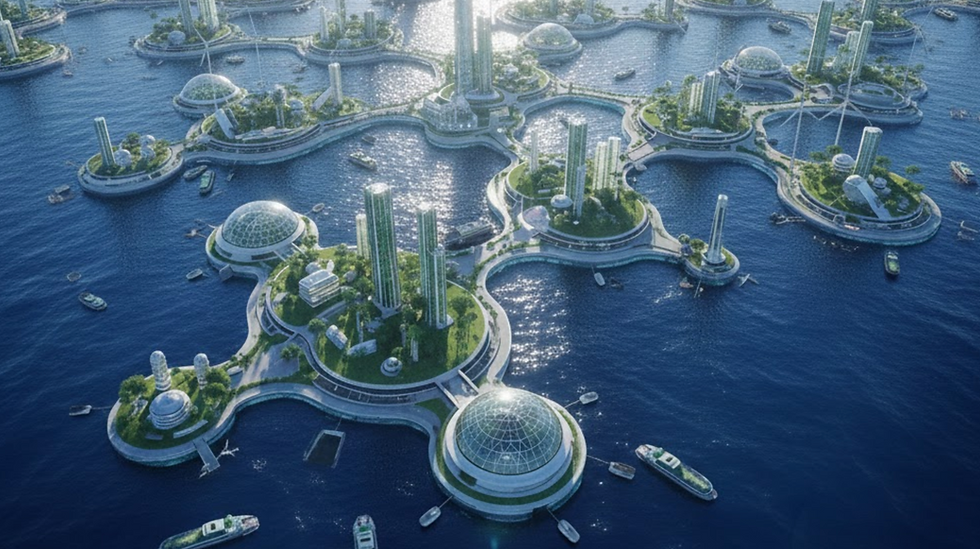
What matters is not the inherent flaws of these maritime civilizations themselves, but rather that the technology, institutions, and ideas of the time had not yet caught up with the sea as a civilization. In other words, these maritime civilizations could be described as “premature attempts.”
However, for the first time in history, the conditions necessary to complete this unfinished endeavor are now coming together.
・The technology to safely settle at sea
・The concept of circulating energy, water, and food at sea
・Resilience design premised on disasters (a design philosophy that assumes survival and rebuilding even after destruction)
・A shared understanding of cooperation and public good beyond national frameworks
・An ethical perspective that chooses symbiosis over domination
In other words, we have now reached the stage where we can transition to a civilization that lives in harmony with the ocean.
The future of ocean civilization will not begin by floating massive, fixed cities on the sea, but rather by building flexible, multipurpose, and disaster-resilient social infrastructure atop the ocean—infrastructure that can move as needed, reconfigure its functions, and scale itself. This is not a civilization that conquers the sea, but one that continually adapts alongside it.
Marine civilization once declined. But perhaps that was not a failure, but rather a period of preparation while waiting for the right conditions to arise.
After traversing various historical eras, we now finally possess those conditions for the first time. What is being asked is not merely the technical success or failure of “Can we build cities on the sea?” but perhaps humanity's very stance itself: “How do we design a civilization premised on the sea?”


Comments